A patient's guide to stroke prevention in AFib
The Watchman DeviceA Cardiologist's Guide to Left Atrial Appendage Closure
A small implant that closes off the pouch where most stroke-causing clots form in AFib, so you can eventually stop your blood thinner. Who it suits, what the trials show, and what the months afterward look like.

90%
about how many of the clots that travel and cause a stroke in non-valvular AFib trace back to one small pouch
1 hour
about how long the procedure takes, and most people go home the next day
45 days
until the ultrasound check that decides when the blood thinner stops
99%
or higher implant success for the current Watchman FLX in clinical practice
If you have atrial fibrillation and you’ve been told you need a blood thinner to prevent a stroke, you’re not alone. Atrial fibrillation is the most common heart rhythm disorder in the world, and stroke prevention is the main reason we treat it. For most patients, that means taking an oral anticoagulant, either warfarin or one of the newer direct oral anticoagulants (DOACs) like Eliquis or Xarelto. These medications work well for the majority of people who take them.
But not everyone can tolerate a blood thinner. Some patients have had life-threatening bleeding episodes on anticoagulation. Others have conditions that make the bleeding risk unacceptably high. And some patients simply cannot stay on these medications long term for a variety of medical reasons. For these patients, there’s now a structural alternative. The Watchman device is a small implant that seals off the part of the heart where most stroke-causing blood clots form in atrial fibrillation.
As a cardiologist who implants the Watchman device, I explain here what it is, who it’s for, what the evidence says, how the procedure works, and what to expect afterward, including the latest clinical trial data through 2026.
Where the clots come from
The left atrial appendage, and the device that closes it
To understand the Watchman device, you first need to understand the left atrial appendage (LAA). The LAA is a small, finger-shaped pouch that extends off the left atrium of your heart.
In people with a normal heart rhythm, the LAA contracts along with the rest of the atrium and blood flows in and out of it normally. It doesn’t cause any problems.
In atrial fibrillation, the left atrium doesn’t contract effectively. Instead, it quivers. This means blood can pool and stagnate inside the LAA, and stagnant blood has a tendency to form clots. If a clot forms in the LAA and then breaks free, it can travel through the bloodstream to the brain and cause a stroke. In atrial fibrillation that isn’t caused by a heart valve problem (called non-valvular atrial fibrillation), about 90% of the blood clots that travel and cause a stroke are traced to the left atrial appendage. That’s a remarkably high percentage from a single anatomical structure, and it’s the reason the LAA became a target for intervention.


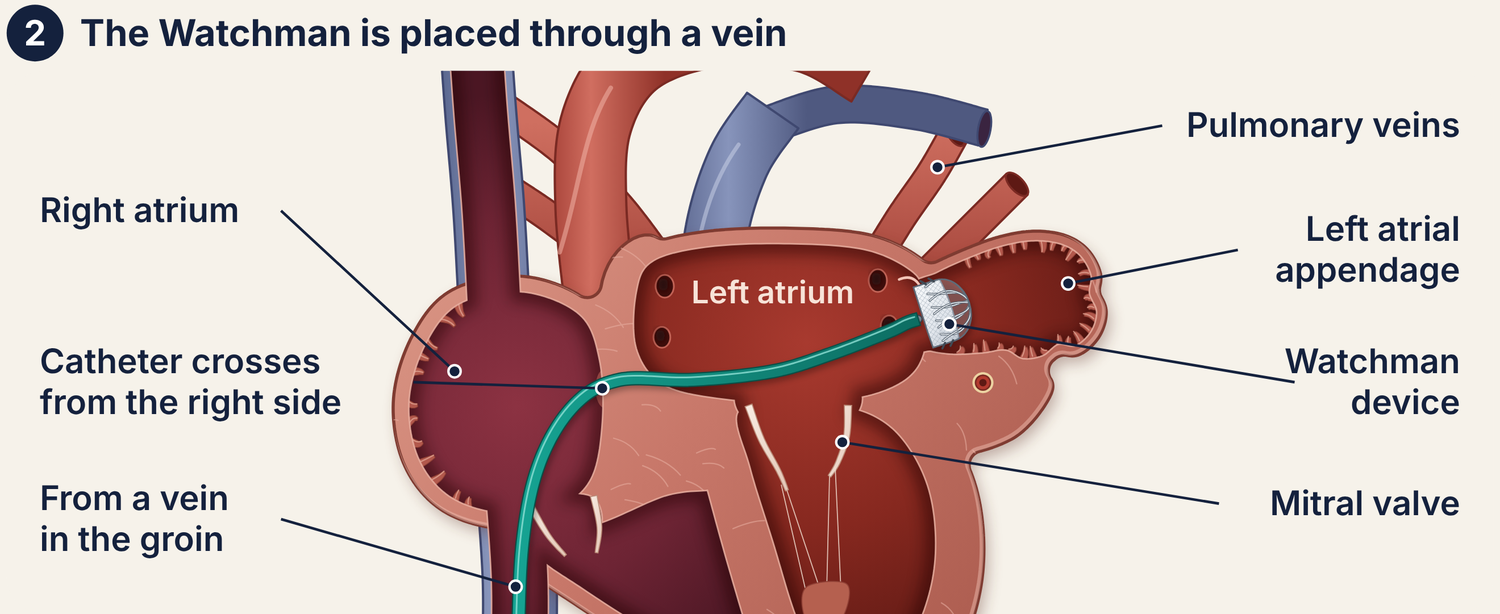

Where the clots come from, and how the Watchman closes it off. In AFib, blood pools in the appendage and can clot. The device goes in through a vein and plugs the opening. Over the following weeks to months, your own tissue grows over it.
What the Watchman is
The Watchman (manufactured by Boston Scientific) is a small, self-expanding device made of a nitinol frame covered with a fabric membrane. It looks something like a tiny parachute or mushroom cap. The device is implanted into the opening of the left atrial appendage, where it acts as a permanent plug. Once in place, it blocks blood from entering and pooling in the appendage. Over the following weeks to months, your body’s own tissue grows over the device surface, effectively sealing the LAA off from the rest of the heart.
The concept is straightforward. If 90% of clots in atrial fibrillation come from the LAA, and you seal the LAA shut, you eliminate the primary source of those clots. This allows patients to eventually stop taking blood thinners while maintaining stroke protection.
In short, a catheter carries the folded device up from a vein in the groin, it opens in the mouth of the appendage and plugs it, and tissue later grows over it.
The current generation device is the Watchman FLX, which was approved by the FDA in 2020. It represents a major improvement over the original Watchman device, with a shorter profile, a wider range of appendage sizes it can treat, a fully closed end cap, and a redesigned anchoring system. The FLX has demonstrated a 99% or higher implant success rate in clinical practice.
Who it’s for
Who is a candidate for the Watchman?
The Watchman is not meant to replace blood thinners for everyone with atrial fibrillation. It’s designed for a specific subset of patients. Understanding who benefits from this device is one of the most important aspects of the decision.
The traditional indication, for patients who can’t tolerate anticoagulation
The original and most well-established indication for the Watchman is patients with non-valvular atrial fibrillation who have a reason to be on long-term anticoagulation (based on their CHA2DS2-VASc score) but who have a contraindication to or a strong reason to avoid oral anticoagulants. Common scenarios I see in practice include patients who have had a major gastrointestinal bleed on blood thinners, patients with a history of intracranial hemorrhage (bleeding in the brain), patients who have recurrent falls with a high risk of injury, and patients with other conditions that create an unacceptable bleeding risk on long-term anticoagulation.
The CHA2DS2-VASc score adds up points for the things that raise stroke risk in AFib. The 2023 US guideline uses CHA2DS2-VASc. Europe’s 2024 guideline uses CHA2DS2-VA, which drops the point for being female. Tap everything that applies to you to see where the 2023 US guideline places your score.
0 points on CHA₂DS₂-VASc
Tap what applies
Your result shows here as you tap. With nothing tapped, a man scores 0, where a blood thinner is usually not needed.
Under Europe’s 2024 version, CHA₂DS₂-VA, which leaves out the point for being female, the score is 0.
Your cardiologist reads this with your full history. Bring your result to your visit.
For people with AFib that isn’t caused by a heart valve problem. The thresholds are 2 or more for men and 3 or more for women for a blood thinner to be recommended. The tool shows a band, not a stroke percentage, because published rates vary too much between studies.
The 2023 ACC/AHA/ACCP/HRS Atrial Fibrillation Guidelines and the 2023 SCAI/HRS expert consensus statement both support left atrial appendage occlusion (LAAO) as a reasonable option for patients with NVAF (non-valvular AFib) who have contraindications to long-term oral anticoagulation. The guidelines emphasize shared decision-making and require that patients have an adequate life expectancy (in general, more than one year) to benefit from the procedure.
The expanding role, with the Watchman as a first-line alternative
More recent clinical trial data has begun to shift how we think about the Watchman. The CHAMPION AF trial, which enrolled 3,000 patients who were able to take blood thinners and was published in the New England Journal of Medicine in 2026, compared the Watchman FLX head-to-head against DOACs as a first-line stroke prevention strategy. This was the first large randomized trial to test the device against modern anticoagulants (the earlier trials compared Watchman to warfarin, not DOACs).
The Watchman FLX met its main goal. Over three years, the combined rate of death from heart or blood vessel causes, stroke, or a clot lodging elsewhere in the body (a systemic embolism) was 5.7% with the device and 4.8% with DOACs. That 0.9-point gap fell within the margin the trial set in advance, so the device was judged noninferior, meaning not meaningfully worse. For bleeding, the device was superior. Major bleeding plus smaller bleeds that still needed medical attention, not counting bleeding from the procedure itself, happened less often with the Watchman.
death from heart or blood vessel causes, stroke, or systemic embolism over three years, Watchman FLX vs. DOACs. Judged noninferior.
more ischemic strokes plus clots lodging elsewhere with the device, roughly 1 percentage point over three years. Five-year results are pending.
There are important caveats. Strokes caused by a clot (ischemic strokes) plus clots lodging elsewhere ran about 1 percentage point higher with the device over three years, or roughly 0.3% per year. The five-year results are still pending, and they will show whether that gap holds, grows, or narrows as tissue fully covers the device. The trial was also run by the device’s manufacturer, which is common for device trials but worth knowing.
CHAMPION AF shows that for patients who are eligible for either approach, the Watchman FLX offers protection that is close to DOACs, with less bleeding, at the cost of a small excess of clot-related strokes that longer follow-up has to clarify. This is relevant because bleeding complications on anticoagulants are not rare. They accumulate over years, and for patients who are going to need stroke prevention for decades, the idea of achieving that protection without lifelong medication exposure is appealing.
Post-ablation patients and the OPTION trial
Another recent trial that expanded the role of LAAO is the OPTION trial, which enrolled approximately 1,600 patients undergoing catheter ablation for atrial fibrillation. In this study, patients were randomized to receive the Watchman FLX (either at the same time as their ablation or within a short window after) versus continuing oral anticoagulation.
At 36 months, OPTION demonstrated noninferiority for the primary efficacy endpoint (stroke, systemic embolism, and unexplained death, 5.4% vs. 5.8%) and superiority for the primary safety endpoint (non-procedural bleeding, 8.5% vs. 18.1%, P less than 0.0001). The implant success rate was 99%, and 40.8% of patients had the Watchman implanted at the same time as their ablation procedure.
See the same numbers as a table
| OPTION outcome | Watchman FLX | Stayed on a blood thinner |
|---|---|---|
| Stroke, systemic embolism or unexplained death | 5.4% | 5.8% |
| Non-procedural bleeding | 8.5% | 18.1% |
This trial led to an updated FDA indication for the Watchman, now including patients undergoing catheter ablation who have an indication for long-term anticoagulation. For patients already in the electrophysiology lab for an ablation, the option to address both the rhythm problem and the stroke risk in a single procedure is a meaningful advance.
The evidence base
A summary of the major trials
The Watchman device has the most extensive clinical trial program of any structural heart device. The main studies are summarized below.
PROTECT AF · 2009-2014
707 patients, Watchman vs. warfarin
The first randomized trial of the Watchman device. The five-year results, published in the Journal of the American College of Cardiology, demonstrated that the Watchman was noninferior to warfarin for the combined endpoint of stroke, systemic embolism, and cardiovascular death. The device showed superiority for hemorrhagic stroke, cardiovascular death, and all-cause mortality at five years. There was a higher rate of pericardial effusion early after implantation, reflecting the procedural learning curve at the time.
PREVAIL · 2013-2014
407 patients, a similar design
The second randomized trial, built on a design similar to PROTECT AF. The study did not meet one of its two coprimary efficacy endpoints individually (a late-efficacy endpoint). The five-year pooled analysis combining PROTECT AF and PREVAIL data confirmed the overall stroke prevention benefit, with comparable efficacy to warfarin, superior safety for major bleeding events (1.7% vs. 3.6% per year), and superior outcomes for hemorrhagic stroke, disabling stroke, and all-cause mortality.
OPTION · 2024-2025
Watchman after catheter ablation
This trial established the role of Watchman implantation in patients undergoing catheter ablation, showing noninferior efficacy and superior safety compared to continued anticoagulation. It demonstrated that combining ablation and LAAO in a single procedure is both safe and effective.
CHAMPION AF · 2026
About 3,000 patients, Watchman FLX vs. DOACs
As discussed above, this was the first large randomized trial comparing the Watchman FLX to DOACs (rather than warfarin). It demonstrated noninferiority for its main combined endpoint and superiority for bleeding reduction. The small excess of clot-related strokes in the device arm will be followed in the five-year data.
The procedure
How the Watchman procedure works
The Watchman is implanted through a catheter-based procedure, which means there is no open-heart surgery involved. The procedure is performed under general anesthesia in a cardiac catheterization laboratory and typically takes about one hour.
Step by step
- The route in
- A catheter is inserted through a vein in your groin (the femoral vein) and advanced to your heart. To reach the left atrium, it crosses from the right atrium to the left atrium through the interatrial septum, the wall between the two upper chambers, using a technique called transseptal puncture. This is a routine technique that interventional and structural cardiologists perform regularly.
- Measuring
- The dimensions and shape of your left atrial appendage are measured using a combination of fluoroscopy (X-ray imaging) and transesophageal echocardiography (TEE), which provides real-time ultrasound images of the heart from within the esophagus.
- Placing it
- The appropriately sized Watchman device is loaded onto a delivery catheter, positioned at the opening of the LAA, and deployed. The device self-expands and anchors into the appendage.
- The PASS check
- The implanting physician performs a series of standardized tests (called the PASS criteria, for Position, Anchor, Size, Seal) to confirm that the device is properly positioned, securely anchored, appropriately sized, and adequately sealing the appendage opening. If the device doesn’t meet these criteria, it can be recaptured and repositioned, or a different size can be selected. Once everything looks right, the device is released and the catheters are removed.
- Going home
- Most patients go home the next day. The transseptal puncture site in the septum heals on its own within a few weeks, and the small access site in the groin typically heals within a day or two.
Your medicines afterward
Post-implant medication protocol
One of the most common questions I get from patients is, “If the whole point is to get off blood thinners, why do I need to take them after the procedure?” It’s a fair question. The device needs time for your body’s tissue to grow over its surface and create a biological seal. Until that process is complete, you need some form of anticoagulation or antiplatelet therapy to prevent clots from forming on the device itself.
- First 45 daysWarfarin plus aspirinThe plan used in PROTECT AF and PREVAIL. Until tissue covers the device, this keeps clots from forming on it.
- At 45 daysThe TEE checkAn ultrasound from inside the esophagus looks for a clot on the device and for a leak wider than 5 mm. No clot and no large leak, and the blood thinner stops.
- To the six-month markAspirin plus clopidogrelDAPT with clopidogrel (Plavix) until six months after the procedure. The six months count from the implant day, so this stretch lasts about four and a half months.
- After thatAspirin alone, indefinitelyClopidogrel stops. In some cases, no antithrombotic medicine at all once the device has fully healed, decided case by case with your cardiologist.
The original trial plan. Warfarin plus aspirin for 45 days, as in PROTECT AF and PREVAIL.
The standard protocol
The protocol used in the original clinical trials (PROTECT AF and PREVAIL) calls for warfarin plus aspirin for 45 days after implantation. At 45 days, a transesophageal echocardiogram (TEE) is performed to check for device-related thrombus (a blood clot on the device) and for a large leak around the device, meaning a gap wider than 5 mm. If the TEE shows no clot and no large leak, the blood thinner is stopped and the patient transitions to dual antiplatelet therapy (DAPT), typically aspirin plus clopidogrel (Plavix), until six months after the procedure. The six months are counted from the day of the implant, so this stretch lasts about four and a half months. After that, the clopidogrel is stopped and the patient continues on aspirin alone indefinitely.
The full timeline runs like this. A blood thinner plus aspirin for 45 days, then DAPT (aspirin plus clopidogrel) until the six-month mark after the procedure, then aspirin alone lifelong.
The DOAC-based protocol
In current practice, many centers (including mine) use a DOAC instead of warfarin for the initial 45-day post-implant period. The Watchman FLX label allows a DOAC plus aspirin, and most patients who can tolerate short-term anticoagulation prefer a DOAC to warfarin. The remainder of the protocol is the same. A TEE at 45 days, then DAPT until six months after the procedure, then aspirin alone.
Some registry data suggest that a blood thinner alone, without aspirin, during the first 45 days leads to fewer problems, mainly less bleeding. That regimen is not part of the device’s approved labeling, so it counts as off-label, and your implanting team would decide whether it fits you.
The DAPT protocol, for patients who cannot take any anticoagulant
For patients who are receiving the Watchman specifically because they cannot tolerate any anticoagulant, including short-term use, the Watchman FLX label now includes a third option. These patients take DAPT (aspirin plus clopidogrel) for the first 45 days in place of a blood thinner, starting right after the procedure. The 45-day TEE still happens, and the plan after that follows the same path toward aspirin alone.
The choice among these regimens depends on each patient’s individual bleeding risk, their ability to tolerate short-term anticoagulation, and physician judgment. In all cases, the long-term goal is the same. The patient ends up on aspirin alone (or in some cases, no antithrombotic therapy at all) once the device is fully healed.
If you miss a dose before the 45-day check
Neither the guidelines nor the device studies spell out what to do after a missed dose during the first 45 days. Follow the missed-dose directions on the label of the specific medicine you take, and call the team that implanted your device so they can tell you whether anything about your plan should change.
Potential complications
Risks, and when to call 911
The Watchman procedure is considered safe, but like any invasive cardiac procedure, it carries risks. Understanding these is part of making an informed decision.
Possible complications
- Pericardial effusion
- Fluid or blood collecting around the heart is the most common serious procedural complication. It can occur during the transseptal puncture or during device deployment. In the large NCDR (National Cardiovascular Data Registry) dataset, the rate serious enough to need treatment was approximately 1.35%. With the newer Watchman FLX, the rate is about 1.0%. An effusion can also show up days to weeks after the procedure, after you are home, which is why you should know the warning signs. Most cases can be managed with a pericardiocentesis (draining the fluid with a needle) without the need for surgery.
- Device-related thrombus (DRT)
- A blood clot that forms on the surface of the device before it has been fully covered by tissue, reported in approximately 3.7% to 6.6% of patients in various studies. This is why the 45-day TEE is so important. If a DRT is detected, the treatment is typically a course of anticoagulation therapy (usually three to six months) until repeat imaging confirms the clot has resolved. In most cases, DRT can be treated successfully without long-term consequences, though it is associated with a modestly higher risk of stroke if not detected and treated.
- Device embolization
- The device dislodging from the LAA and migrating to another part of the heart or vasculature is rare, occurring in approximately 0.2% to 0.7% of cases. When it does occur, it typically requires a percutaneous retrieval procedure (through a catheter) or, rarely, surgical removal. The risk has decreased substantially with the Watchman FLX compared to the original device, thanks to improved anchoring and a wider range of size options.
- Procedure-related stroke
- The risk of stroke during or shortly after the implantation procedure is approximately 0.3% to 0.5%. This risk is minimized by careful procedural technique, appropriate anticoagulation during the procedure, and strict air management (preventing air bubbles from entering the left atrium through the catheter system).
- Peridevice leak
- After the device is deployed, there can be small gaps between the device and the wall of the LAA where blood can leak through. In the main trials that led to approval, a leak under 5 mm counted as an adequate seal. A leak wider than 5 mm counted as a large leak, and those patients stayed on warfarin plus aspirin. The American College of Cardiology notes that leaks of 5 mm or more, and clots on the device, may raise the long-term risk of stroke and are a reason to consider longer-term anticoagulation or, in some cases, a secondary closure procedure. The Watchman FLX has a lower rate of large peridevice leaks compared to the original device.
Call 911 after the procedure
Most people recover without trouble, but some complications can appear after you are home, even weeks later. Call 911 or get emergency care right away if you have any of these.
- Chest discomfort, shortness of breath, or feeling faint or lightheaded
- These can be signs of fluid building up around the heart.
- Signs of a stroke
- A drooping face, weakness or numbness in an arm or leg, trouble speaking, sudden vision loss, or sudden confusion.
- Bleeding or swelling at the groin
- Where the catheter went in.
Follow-up and surveillance
After the implant, the visits are predictable
After Watchman implantation, follow-up is structured and predictable. The most important visit is the 45-day TEE, which checks for device-related thrombus and assesses the seal around the device. If everything looks good at 45 days, the anticoagulant is stopped and DAPT begins.
Some centers perform additional imaging at 12 months to reassess device positioning and check for late DRT, though this practice varies. Beyond that, routine follow-up is with your cardiologist at standard intervals. There is no special long-term maintenance required for the device itself. It’s a permanent implant that stays in place for life.
Once you’ve healed
Patients with a Watchman device can undergo MRI scans (the device is MRI-conditional) and in general have no restrictions on daily activities once fully healed from the procedure.
Making the decision
Watchman vs. blood thinners
The decision between the Watchman and long-term anticoagulation is highly individual. With my patients, I sort it into a few situations.
Can’t tolerate anticoagulation
For patients who have had major bleeding events, intracranial hemorrhage, or other absolute contraindications, the Watchman is often the clearest path forward. These patients are at high risk for stroke but also at high risk from the treatment. The Watchman provides stroke protection without the ongoing bleeding risk of daily medication.
Can take one, worried about years of bleeding
The CHAMPION AF data provides a framework for that conversation. The trial showed that the Watchman FLX provides comparable stroke protection with less bleeding over time, a statistically clear difference. For a patient in their 60s with decades of anticipated anticoagulation ahead, the accumulated bleeding risk of long-term DOACs is real. The Watchman offers a way to get off that trajectory.
Having a catheter ablation
For patients undergoing catheter ablation for atrial fibrillation who also need long-term anticoagulation, the OPTION trial data supports combining the two procedures. Many patients undergoing ablation hope to reduce or eliminate their medications, and the Watchman can help achieve that goal with respect to anticoagulation.
Not the right choice
Patients who do well on their blood thinner with no bleeding complications and no strong desire to stop may have no reason to undergo a procedure. Patients with very short life expectancy (less than one year) are unlikely to derive benefit. And patients with certain LAA anatomies may not be suitable candidates. These are all factors I assess during the evaluation process.
The Watchman procedure at our practice
At my practice in Encinitas, I perform Watchman implantations at Scripps Memorial Hospital. The evaluation process begins with a detailed review of your medical history, your stroke risk score, your bleeding history, and a discussion about your goals and expectations. If we determine together that the Watchman is the right option, we schedule a pre-procedure TEE (or sometimes a cardiac CT scan) to evaluate the anatomy of your left atrial appendage and ensure it’s suitable for the device.
The procedure itself typically takes about an hour, and most patients go home the following day. I see all my Watchman patients for the 45-day TEE follow-up personally, because this visit is when we make the critical decision about stopping the anticoagulant. From that point forward, the goal is straightforward. Keep you protected from stroke with minimal or no blood thinner exposure.
If you have atrial fibrillation and you’re struggling with your anticoagulation, or if you’ve been told you can’t take blood thinners because of bleeding risk, I encourage you to ask about the Watchman. It’s a proven technology backed by over 15 years of clinical trial data, and for the right patient, it can be life-changing. Contact us to schedule a consultation at our Encinitas office.
Questions I hear in clinic
Frequently asked questions about the Watchman device
How long has the Watchman been available?
The original Watchman device received FDA approval in 2015, though it had been studied in clinical trials since 2005. The current-generation Watchman FLX was approved in 2020. Between clinical trials and commercial use, over 500,000 Watchman devices have been implanted worldwide.
Will I be completely off blood thinners after the procedure?
The goal is to get you off oral anticoagulants. After the standard protocol (a blood thinner or DAPT for 45 days, then DAPT until six months after the procedure), most patients end up on aspirin alone. Some patients may eventually come off aspirin as well, though this is decided on a case-by-case basis with your cardiologist.
Is the procedure painful?
The procedure is performed under general anesthesia, so you won’t feel anything during the implantation. After the procedure, some patients experience mild chest discomfort and soreness at the groin access site, both of which typically resolve within a few days.
Can the device be removed if there’s a problem?
The Watchman is designed to be a permanent implant. In extremely rare circumstances (such as device embolization), it can be retrieved percutaneously, through a catheter. In normal use, the device becomes incorporated into the heart tissue and stays in place for life.
Does the Watchman cure atrial fibrillation?
No. The Watchman does not treat the rhythm disorder itself. It addresses stroke risk by closing off the left atrial appendage where clots form. Your atrial fibrillation may still need treatment with rate-controlling medications, rhythm-controlling medications, or catheter ablation. The Watchman and ablation address different aspects of the same condition and can be complementary.
What if my doctor finds a blood clot on the device at the 45-day check?
Device-related thrombus (DRT) is detected in a small percentage of patients. When it is found, the standard approach is to treat with anticoagulation therapy (usually a DOAC or warfarin) for several months until repeat imaging confirms the clot has resolved. In most cases, this is a temporary setback that can be managed effectively without long-term consequences.
AFib still needs care
The Watchman deals with stroke risk only. It does not treat the rhythm disorder itself, so your AFib may still need rate-controlling medications, rhythm-controlling medications, or catheter ablation.

A Watchman decision calls for an unhurried conversation about your stroke risk, your bleeding history, and your alternatives. I have that conversation with patients in Encinitas and with people coming from San Diego. The procedures themselves happen at Scripps.
References
- Reddy VY, Sievert H, Halperin J, et al. "Percutaneous Left Atrial Appendage Closure vs Warfarin for Atrial Fibrillation: A Randomized Clinical Trial (PROTECT AF)." JAMA 312, no. 19 (2014): 1988-1998.
- Holmes DR Jr, Kar S, Price MJ, et al. "Prospective Randomized Evaluation of the Watchman Left Atrial Appendage Closure Device in Patients with Atrial Fibrillation Versus Long-Term Warfarin Therapy (PREVAIL)." Journal of the American College of Cardiology 64, no. 1 (2014): 1-12.
- Reddy VY, Doshi SK, Kar S, et al. "5-Year Outcomes After Left Atrial Appendage Closure: From the PREVAIL and PROTECT AF Trials." Journal of the American College of Cardiology 70, no. 24 (2017): 2964-2975.
- Osmancik P, Herman D, Neuzil P, et al. "4-Year Outcomes After Left Atrial Appendage Closure Versus Antithrombotic Therapy After Catheter Ablation for Atrial Fibrillation (OPTION)." Circulation (2025).
- Doshi SK, Kar S, Nair DG, et al. "Left Atrial Appendage Closure or Anticoagulation for Atrial Fibrillation (CHAMPION AF)." New England Journal of Medicine (2026).
- Freeman JV, Varosy P, Price MJ, et al. "The NCDR Left Atrial Appendage Occlusion Registry." Journal of the American College of Cardiology 75, no. 13 (2020): 1503-1518.
- Dukkipati SR, Kar S, Holmes DR, et al. "Device-Related Thrombus After Left Atrial Appendage Closure: Incidence, Predictors, and Outcomes." Circulation 138, no. 8 (2018): 874-885.
- Joglar JA, Chung MK, Armbruster AL, et al. "2023 ACC/AHA/ACCP/HRS Guideline for Diagnosis and Management of Atrial Fibrillation." Circulation 149, no. 1 (2024): e1-e156.
- Saw J, Holmes DR, Cavalcante JL, et al. "SCAI/HRS Expert Consensus Statement on Transcatheter Left Atrial Appendage Closure." Heart Rhythm (2023).
- Turagam MK, Osmancik P, Neuzil P, et al. "Left Atrial Appendage Closure Versus Oral Anticoagulants in Atrial Fibrillation: A Meta-Analysis." European Heart Journal 46, no. 4 (2025): 301-312.
- Kumbhani DJ, Armbruster AL, Cheng RK, et al. "Direct Oral Anticoagulants in Primary and Secondary Prevention of Thrombotic Events: 2026 ACC Scientific Statement." Journal of the American College of Cardiology (2026).
- Galli M, Gragnano F, Berteotti M, et al. "Antithrombotic Therapy in High Bleeding Risk, Part I: Percutaneous Cardiac Interventions." JACC: Cardiovascular Interventions (2024).
- Shiraki H, Tanaka H, Yamauchi Y, et al. "Characteristics of Non-Valvular Atrial Fibrillation with Left Atrial Appendage Thrombus Who Are Undergoing Appropriate Oral Anticoagulation Therapy." The International Journal of Cardiovascular Imaging (2022).
- Marcus GM. "Left Atrial Appendage Closure: Should Recommendations Be Expanded?" New England Journal of Medicine (2026).
- Rochira C, Mazzapicchi A, Tomasello SD, et al. "Percutaneous Left Atrial Appendage Closure for Stroke Prevention: Current Challenges and Future Perspectives." Clinical Research in Cardiology (2026).
- Kavinsky CJ, Kusumoto FM, Bavry AA, et al. "SCAI/ACC/HRS Institutional and Operator Requirements for Left Atrial Appendage Occlusion." Journal of the American College of Cardiology (2016).
- Ben H, Changsheng M, Shulin W. "2019 Chinese Expert Consensus Statement on Left Atrial Appendage Closure in Patients with Atrial Fibrillation." Pacing and Clinical Electrophysiology (2022).
- Van Gelder IC, Rienstra M, Bunting KV, et al. "2024 ESC Guidelines for the Management of Atrial Fibrillation Developed in Collaboration with the European Association for Cardio-Thoracic Surgery (EACTS)." European Heart Journal 45, no. 36 (2024): 3314-3414. (Source of the CHA2DS2-VA score in the stroke-risk checker.)
Published on damianrasch.com. The above information was composed by Dr. Damian Rasch, drawing on individual insight and bolstered by digital research and writing assistance. The information is for educational purposes only and does not constitute medical advice.