Blood pressure at home
Why I Ask So Many of My Patients to Monitor Their Blood Pressure at Home
Why a week of readings from your kitchen table tells me more than the office cuff, and how to take them so we can trust them.

7 days
of paired morning and evening readings before a visit
28
readings in that week, at two each morning and two each evening
30 min
at least, with no caffeine, exercise or nicotine before a reading
14 in
around the upper arm, about where you likely need a large cuff
I see some version of this scene almost every week. A patient comes in for a follow-up. We chat while the medical assistant puts the cuff on. The reading prints out at 128 over 78. They look at me, I look at the number, we both nod. On the way out, casually, they mention that the cuff they bought from the drug store last month has been showing 148 over 92 every morning at the kitchen table. I ask why they didn’t lead with that. They shrug. They figured the doctor’s reading was the one that counted.
That is the moment I want to talk about. In the great majority of these cases, the kitchen-table cuff is telling the truth and my office cuff is being quietly fooled by the fact that my patient just fought the 5, parked three floors down, rode an elevator, sat in a paper gown, and spent ten minutes making small talk with me. A single clinic reading is a snapshot taken under artificial conditions. The blood pressure that damages arteries, thickens the heart, strains the kidneys, and drives strokes is the blood pressure running through those vessels the other 23 hours of the day.
I have started asking almost every patient with known or suspected high blood pressure to measure at home. It’s no gimmick, and I’m not passing the problem back to them. I ask because it changes what I recommend and how well they do. This page is a longer version of the conversation I have with patients in the exam room about why, and how to do it in a way that helps us make better decisions together.
Why the office number can mislead
The problem with the office cuff
A single blood pressure reading in a doctor’s office is a pretty thin slice of information. It captures one moment, under a specific set of conditions, some of which are anything but relaxing. You are in an unfamiliar place. You hurried to get here. Maybe you had a second cup of coffee in the car. A clinician you don’t see every day is asking you questions. For a meaningful fraction of people, that entire setup pushes the number up.
White coat hypertension
The clinic setup pushes the number up. Depending on which study you read, somewhere between one in six and one in three patients who look hypertensive in the clinic have perfectly normal pressure at home.
Masked hypertension
Less famous but just as important. Some people read in the normal range at the office and run high the rest of the time. These are often busy middle-aged patients, frequently men, frequently physically fit on the outside, who happen to relax in the exam room. Their blood pressure then spikes when they return to work, open their email, drive home in traffic, and sit down to dinner with a glass of wine. Their office number looks fine. Their artery walls and their kidneys know better.
Either pattern can lead us in the wrong direction if we rely only on clinic readings. We can put a patient on medication they don’t need, with the side effects and cost that come with it. Or, more commonly in my experience, we can miss real hypertension for years, telling a patient visit after visit that all is well while damage quietly accumulates.
Out-of-office readings are the reference standard
The major guideline bodies have steadily moved toward treating home or ambulatory readings as the more definitive data. The U.S. Preventive Services Task Force now recommends that before we start blood pressure medication for a new diagnosis, we confirm the number outside the office, either with a 24-hour ambulatory monitor or with a week of structured home readings. The American Heart Association and American College of Cardiology echo the same point. The office reading is the trigger for the conversation. It isn’t the answer.
What a week of readings shows
What home readings catch
Once a patient starts bringing me a log of home readings, I see things I simply could not see before.
Pills she didn’t need
A woman in her late thirties came to me after a prior physician had put her on a low dose of lisinopril based on several office readings in the 140 over 90 range. She had been on it for a year, hated the dry cough, and couldn’t shake the feeling something was off. I asked her to measure at home for a week. Her morning readings ran around 115 over 72. Evening readings were similar. Her true blood pressure, across real life, was normal. She had classic white coat hypertension. We stopped the medication, watched her for three months at home, and she has been off pills ever since. I could not have made that call from the office cuff alone.
High pressure the office missed
A man in his sixties, vigorous, working full time, had office pressures that bounced in the 126 over 82 range for two or three visits in a row. He had been reassured repeatedly. His wife nudged him to check at home. His morning readings were consistently 158 over 98. When we added a simple thiazide and an ACE inhibitor, his home numbers came down into the 120s and his clinic readings stayed right where they had been. Without his home data, I might have spent another year congratulating him on his “controlled” pressure while his left ventricle was quietly thickening.
Timing
For patients already on medication, home readings show me where in the day their pressure is well controlled and where it isn’t. I see patients whose pressure is perfect at 9 a.m. in the office but who are running 160 every night at bedtime. That tells me the morning dose is wearing off by evening and we may need a longer-acting agent or a split-dose regimen. I see others whose morning pressure is high because they take their pills at night and the level has dropped by dawn.
These are not adjustments I can make from two office visits a year. They are easy with a week of paired morning-and-evening readings.
Home monitoring also picks up trends earlier. A patient whose pressure is creeping up month over month at home will show that creep long before a once-yearly office visit catches it. That means we can have the conversation about lifestyle and, if needed, medication while the change is still small. That beats waiting until the number is high enough that two or three drugs are needed.

Getting the dose right
Making medication decisions that match real life
The strongest argument for home monitoring, in my mind, is what it does to our ability to get a patient’s blood pressure under control. Treating hypertension well is less about which drug you pick and more about how quickly and how confidently you adjust the dose to what the body is doing.
A large randomized trial in hypertensive adults in the United Kingdom looked at exactly this. It compared two groups. In one, primary care doctors adjusted medication based on home blood pressure readings the patient took themselves. In the other, doctors adjusted medication based only on office readings. At a year, the home-monitoring group had meaningfully lower blood pressure. The difference was real, the size that translates over a decade into fewer strokes and fewer heart attacks. A second UK trial, running a similar comparison in primary care, found the same thing. When patients tracked at home and we used those numbers to titrate, control improved and improved durably.
An individual-patient-data meta-analysis pooling results from 25 randomized trials found that self-monitoring, on its own, produces a small but real drop in blood pressure. When self-monitoring is combined with support, the drop is much larger. Support can be a nurse or pharmacist reviewing readings, a clinician adjusting medication between visits, or a telehealth check-in. The more we use the home data to do something, the more the numbers move.
Office readings only
Two readings a year, each taken under the most artificial possible conditions.
Self-monitoring on its own
A small but real drop in blood pressure.
Self-monitoring plus support
A much larger drop, when someone on the care team reviews the readings and acts on them.
The reason is simple when you think about it. Without home data, I am making medication decisions from two readings a year. I am hedging. I don’t want to up-titrate in the office because maybe the reading was high today. I don’t want to change medication because maybe the patient is stressed. I tend to wait. The patient waits. Another six months goes by at a higher number than we would both accept if we saw it clearly. With home readings, that ambiguity evaporates. Either the pressure is down or it isn’t. We can act, and we can confirm the action worked in a week, where before it took six months.
Check it at home
Average your week
What I do in clinic, for what it’s worth, is ask patients to bring me seven days of paired readings, one in the morning before medications and breakfast, one in the evening. I throw out the first day, which tends to be higher because it’s new, and I average the rest. That average is what I treat. A 30-second scan of a week’s worth of numbers tells me more about whether a medication is working than a single office reading ever will.
Type in your week of readings, top number and bottom number, one per row. Leave out the first day, which tends to run high because it's new, and enter the rest. Add rows as you go, up to 28.
Your average
--/--
Enter at least two readings to see your average. One reading on its own can mislead.
For adults with high blood pressure, the 2025 AHA/ACC guideline goal is under 130/80, with a top number under 120 encouraged for people at higher risk. Your cardiologist sets your own goal.
Your cardiologist reads this with your full history and sets the plan. Bring your log and this average to your visit.
This sorts an average into the 2025 AHA/ACC guideline ranges. It doesn't diagnose high blood pressure, and nothing you type leaves this page.
Why the average counts
Better numbers mean fewer strokes
Blood pressure is the single most consequential modifiable risk factor in cardiovascular medicine. It is the leading driver of stroke, a major contributor to heart attack and heart failure, and one of the two biggest accelerators of chronic kidney disease. Even modest sustained drops in blood pressure translate, over years, into meaningfully fewer strokes and heart attacks. Research on this is unusually consistent.
Home monitoring does not magically lower anyone’s pressure by itself. A cuff on a kitchen counter is not a medication. What it does is close the loop. It gets patients to a correct diagnosis faster, gets them to the right dose faster, and keeps them there. The downstream benefit, the fewer strokes part, comes from living with better-controlled pressure year after year. The home cuff is how we get there.
There is also a quieter benefit that I think gets less credit than it deserves. Patients who see their own numbers every day start to understand their blood pressure as a lived thing. It stops being an abstraction. They notice that a bad night of sleep runs the number up. They notice that the week after they cut back on takeout the number is lower. They notice that skipping their evening medication shows up on the cuff the next morning. A cuff turns an invisible problem into something a person can see. That reshapes behavior in ways that pills alone often can’t.
What finally made salt real
I have had patients tell me, years after starting home monitoring, that the thing that finally made them take salt seriously wasn’t me lecturing them about DASH. It was watching their cuff hit 148 the morning after a restaurant meal. That kind of realization lands differently than a pamphlet.
How to measure
Choosing a monitor and using it well
Not all home blood pressure monitors are created equal. For this to be useful, the device has to be accurate, and the technique has to be right.
What to look for in a cuff
Upper-arm cuff, not wrist or finger
Wrist devices are convenient, but they are much more sensitive to how you hold your arm, and their accuracy in real use is much worse. I do not recommend them for routine monitoring.
A validated device
This makes a bigger difference than people realize. Not every monitor sold in a pharmacy has been tested against a reference standard. The nonprofit registries STRIDE BP and the Validated Device Listing maintain up-to-date lists of monitors that have passed independent accuracy testing. Brand names that tend to show up on those lists include Omron, Microlife, and A&D, among others. If the device you own is not on one of those lists, it may still be fine, but I would trust a listed one more.
The right cuff size
An ill-fitting cuff is probably the single most common source of bad home readings. A cuff that is too small will read artificially high, and one that is too large will read artificially low. Most standard cuffs fit average upper arms. If your arm circumference is above about 14 inches, you likely need a large cuff. Measure with a tape before you buy, or look for a device that comes with interchangeable sizes.
Memory and Bluetooth are nice to have
They aren’t required. Many modern devices connect to a phone app and save readings automatically. That’s convenient. If you prefer writing readings in a paper notebook, that’s also fine. What counts is that we can see a week of readings when you come in.
Taking a reading, step by step
Technique affects the numbers as much as the device does. A validated cuff used sloppily will give unreliable numbers. The evening before you take readings, look at this short list and make it part of the ritual. Tap a step to see the details.
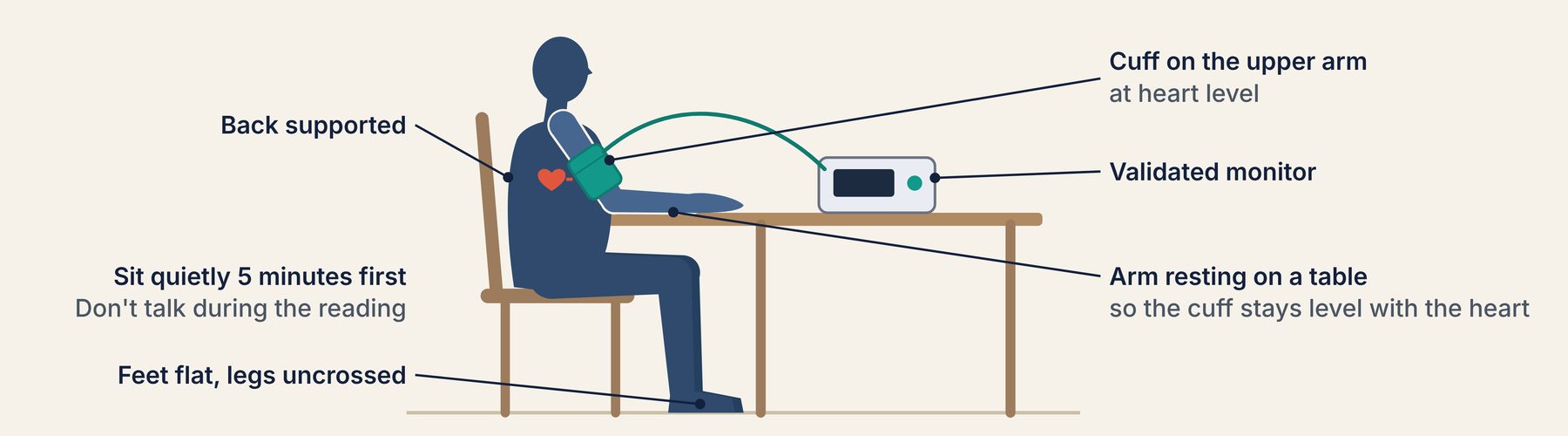
Set up every reading the same way. Back supported, feet flat, legs uncrossed, and the cuff on the upper arm at heart level.
Step 1 of 5
No caffeine, exercise or nicotine
Give yourself at least 30 minutes without caffeine, exercise or nicotine before a reading.
These steps make your numbers trustworthy. Your cardiologist reads them and sets the plan.
The week before a visit
- Measure twice in the morning, before you have coffee or take medication.
- Measure twice in the evening.
- Do that for seven days. That gives me about 28 readings to look at, which is more than enough to see the pattern.
- If you can only manage once a day, that is fine too. Something is better than nothing.
Don’t chase a single high reading
Everyone’s blood pressure spikes sometimes, after exercise, after an argument, after a stressful phone call. Running a second reading and getting a high number doesn’t mean something is wrong. The number to trust is the average over several days. If your individual readings bounce around but your week-long average is fine, you are fine. If your average is high, we have something to talk about. Don’t spend your energy worrying about the outliers.
Working together
How we work together on the data
Home monitoring is not about turning my patients into their own doctors. It gives us better raw material for the conversation we are already having.
In my practice, the typical flow looks like this.
- First visitAt an initial visit where we suspect hypertension, I ask the patient to get a validated upper-arm cuff and measure twice in the morning and twice in the evening for a week.
- A week or two laterThey bring the readings to a follow-up visit, either on paper, or through an app that lets us see them, or sometimes just as photos of the device screen. We look at the average together.
- If the average is highWe talk about what to do. If it’s normal, we drop the concern or, depending on the circumstances, we repeat the process a few months later.
- Already on medicationWe use the same weekly ritual before each follow-up to see whether the current regimen is doing its job.
Team-based care
For many patients, a nurse or pharmacist on my team reviews the readings between visits and flags anything that looks off. This kind of team-based care has been studied and it works. Trials that pair home monitoring with clinician or pharmacist support consistently show better blood pressure control than home monitoring alone, which in turn is better than usual care. The more active a role the monitoring data plays in ongoing decisions, the more benefit patients get from it.
Telehealth
For patients who live far from the office, or who travel, or who simply prefer it, we can review home readings and titrate medications by video visit. That ability has changed a great deal for patients in more rural parts of the county who used to delay follow-up because a 40-minute drive each way for a 10-minute conversation didn’t feel worth it. With a cuff at home and a video visit, we can have the same conversation without any of that friction.
Insurance
Medicare recognizes two specific billing codes for self-measured blood pressure monitoring. One covers the initial visit where the patient is trained on the device and the process. The other covers monthly collection and interpretation of home readings, when the patient is doing the measurements on a validated device as instructed. Many commercial insurers follow Medicare’s lead on these.
A word about insurance, because I get asked. In practice, the time my team and I spend reviewing your home data is a reimbursable service, which has made it much easier for practices like mine to build this into routine care. It used to be treated as an add-on. You don’t need to know the codes. The point is that the system is finally catching up to the evidence, and the visits around your home cuff are real medical care, more than a courtesy.
What a home cuff can’t do
A few things home monitoring isn’t
I don’t want to oversell this. There are a few things a home cuff does not replace, and a few ways it can go wrong.
It doesn’t replace visits
- Being seen in person
- Blood pressure is only one piece of cardiovascular care. I still need to listen to your heart, look at your ankles, check your labs, look at your ECG now and then. Home monitoring makes the in-person visit more productive. It does not eliminate it.
It isn’t a license to self-medicate
- Extra doses
- I have had patients, well-intentioned, take an extra dose of their beta blocker because their morning reading was high. That is not how these medications work, and it sometimes causes more trouble than the high reading would have.
- If a reading worries you
- Message the office or call the triage line. If you have symptoms with a very high reading, call 911. Do not improvise doses on your own.
Sometimes we still want a 24-hour monitor
- When
- For certain specific questions, such as suspected nocturnal hypertension, resistant hypertension, or a strong suspicion of white coat effect despite borderline home readings.
- What it does
- It captures a reading every 20 to 30 minutes for a day and night, including during sleep. For the patients who need it, it gives information a home cuff can’t. It is a test we order less often than we used to, because the home cuff answers most questions, but it still has a role.
Call 911
a crisis, not home monitoring
- A very high reading
- Above 180 on top or above 120 on the bottom.
- With symptoms
- Chest pain, shortness of breath, weakness or numbness, vision changes, confusion or a severe headache.
- No symptoms
- Sit quietly for 5 minutes and check again, then call the office the same day.
- Why
- Home monitoring is for tracking the steady state and guiding treatment. It is not the right tool for crises.
Why I keep asking
Measured in life, not in the office
Cardiology has shifted slowly, over the last couple of decades, away from treating hypertension as something we measure in the office and toward treating it as something we measure in life. The office reading is still useful. It starts conversations, it catches cases we might otherwise have missed, and it anchors us. But it is no longer the number I treat.
What I treat is the average of what your body is doing across a week, in your kitchen, in your car, on your couch, at your desk. That number is what damages arteries. That number is what we need to bring down.
A good home cuff costs about the price of a nice dinner. Learning the technique takes ten minutes. A week of readings before each of your visits takes a few minutes a day. In return, we get a far clearer picture of your heart’s workload than any amount of office cuffs can give us, and we get it in time to act on it. I cannot think of another thing I ask my patients to do that has a better ratio of effort to benefit.
Bring your readings
If you have high blood pressure, or if we’re still trying to figure out whether you do, and you don’t yet have a validated upper-arm cuff at home, please put one on your shopping list. And bring your readings to our next visit. I promise you they will change the conversation for the better.

References
- Whelton PK, Carey RM, Aronow WS, et al. "2017 ACC/AHA/AAPA/ABC/ACPM/AGS/APhA/ASH/ASPC/NMA/PCNA guideline for the prevention, detection, evaluation, and management of high blood pressure in adults." Hypertension. 2018;71(6):e13–e115.
- Jones DW, Ferdinand KC, Taler SJ, et al. "2025 AHA/ACC/AANP/AAPA/ABC/ACCP/ACPM/AGS/AMA/ASPC/NMA/PCNA/SGIM guideline for the prevention, detection, evaluation and management of high blood pressure in adults." Circulation. 2025;152(11):e114–e218.
- US Preventive Services Task Force. "Screening for hypertension in adults: US Preventive Services Task Force reaffirmation recommendation statement." JAMA. 2021;325(16):1650–1656.
- McManus RJ, Mant J, Franssen M, et al. "Efficacy of self-monitored blood pressure, with or without telemonitoring, for titration of antihypertensive medication (TASMINH4): an unmasked randomised controlled trial." Lancet. 2018;391(10124):949–959.
- McManus RJ, Little P, Stuart B, et al. "Home and Online Management and Evaluation of Blood Pressure (HOME BP) using a digital intervention in poorly controlled hypertension: randomised controlled trial." BMJ. 2021;372:m4858.
- Tucker KL, Sheppard JP, Stevens R, et al. "Self-monitoring of blood pressure in hypertension: a systematic review and individual patient data meta-analysis." PLoS Medicine. 2017;14(9):e1002389.
- Shimbo D, Artinian NT, Basile JN, et al. "Self-measured blood pressure monitoring at home: a joint policy statement from the American Heart Association and American Medical Association." Circulation. 2020;142(4):e42–e63.
- Martinez-Ibanez P, Marco-Moreno I, Martinez-Ibanez L, et al. "Long-term effect of home blood pressure self-monitoring plus medication self-titration for patients with hypertension: a secondary analysis of the ADAMPA randomized clinical trial." JAMA Network Open. 2024;7(4):e248492.
- Stergiou GS, Palatini P, Parati G, et al. "2021 European Society of Hypertension practice guidelines for office and out-of-office blood pressure measurement." Journal of Hypertension. 2021;39(7):1293–1302.
- Uhlig K, Patel K, Ip S, Kitsios GD, Balk EM. "Self-measured blood pressure monitoring in the management of hypertension: a systematic review and meta-analysis." Annals of Internal Medicine. 2013;159(3):185–194.
- American Medical Association. "Self-measured blood pressure monitoring: coding (CPT 99473 and 99474) and reimbursement overview." AMA Practice Management Resources, updated 2024.
- Monahan M, Jowett S, Nickless A, et al. "Cost-effectiveness of telemonitoring and self-monitoring of blood pressure for antihypertensive titration in primary care (TASMINH4)." Hypertension. 2019;73(6):1231–1239.
- Stergiou GS, Alpert B, Mieke S, et al. "A universal standard for the validation of blood pressure measuring devices: Association for the Advancement of Medical Instrumentation/European Society of Hypertension/International Organization for Standardization (AAMI/ESH/ISO) collaboration statement." Hypertension. 2018;71(3):368–374.