A leaky heart valve, explained
Understanding Aortic RegurgitationA Complete Patient Guide
Your aortic valve doesn't close all the way, so some blood leaks back into the heart. How the heart adapts, how the leak is graded, and when surgery makes sense.

2–3%
of adults have aortic regurgitation, more common than you might think
60 mL
or more leaking back with each beat is a severe leak
55%
an ejection fraction at or below this is a reason for surgery, even without symptoms
15–20 yrs
how long a tissue valve typically works well
When I tell patients they have aortic regurgitation, I often see a flash of concern cross their faces. The name sounds scary, and the word “regurgitation” doesn’t help. I want you to know from the start that aortic regurgitation is one of the most manageable heart valve conditions we see today. With proper understanding and care, most of my patients with this condition live full, active lives.
Aortic regurgitation means your aortic valve doesn’t close completely after each heartbeat, allowing some blood to leak back into your heart’s main pumping chamber. Think of it like a door that doesn’t quite shut all the way. Your heart is very adaptable, and it adjusts to this leak by growing stronger and pumping more blood with each beat. This adaptation works so well that many of my patients feel perfectly normal for years, even decades.
The condition affects roughly 2 to 3% of adults, making it more common than you might think. I’ve been treating patients with aortic regurgitation for over a decade here in San Diego, and I’ve watched treatment options improve dramatically. What excites me most is how we can now predict when intervention is needed and time it to preserve your heart function and quality of life.
How it works
How your heart adapts to a leaky valve
Your aortic valve sits between your heart’s main pumping chamber (the left ventricle) and your body’s main artery (the aorta). When it works properly, it opens to let blood flow out to your body, then snaps shut to keep blood from flowing backward. In aortic regurgitation, the valve flaps (leaflets) don’t seal completely, creating a leak.
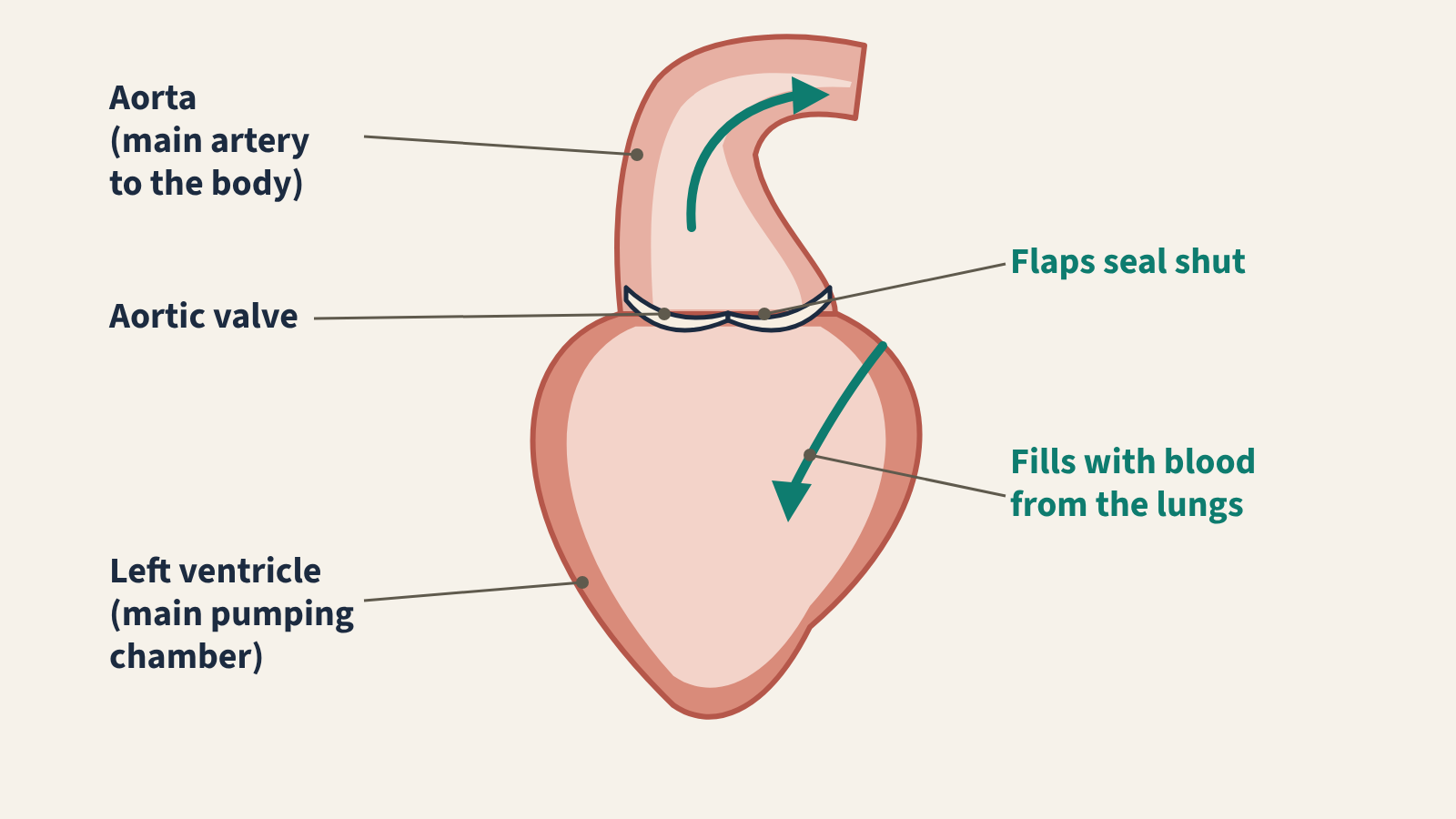
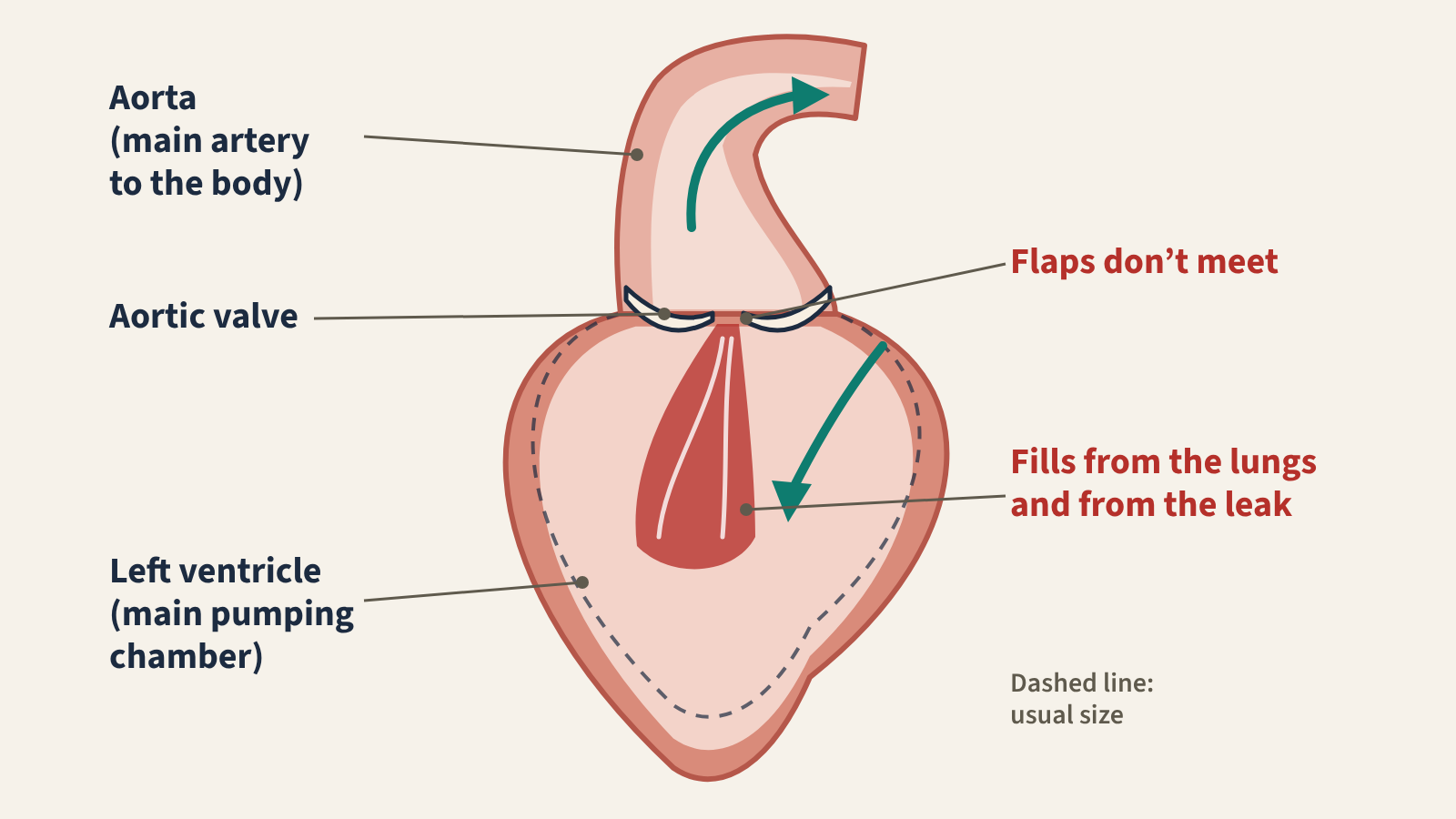
- The valve between beats
- The flaps snap shut
- The main pumping chamber
- Fills with blood from the lungs only
- Over the years
- Keeps its usual size
- A typical blood pressure
- Something like 120/80
A healthy aortic valve. It opens to let blood out to your body, then snaps shut so nothing flows backward while the heart relaxes and refills.
A simplified drawing of the heart relaxing between beats. Your aortic valve sits between the main pumping chamber (the left ventricle) and the body’s main artery (the aorta).
With each heartbeat, your left ventricle fills with blood from two sources. One is the normal flow from your lungs. The other is the blood leaking back through the faulty valve. Your heart has to pump more blood than usual to deliver the same amount to your body. The left ventricle responds by enlarging and strengthening itself, much like your bicep grows when you lift weights regularly.
This adaptation is very effective. In mild to moderate aortic regurgitation, your heart compensates so well that you may never have symptoms. Your resting heart rate might be slightly lower than average, because each beat pumps more blood than normal. You might notice a stronger pulse, especially in your neck, because your heart is pumping more blood with greater force.
The “wide pulse pressure”
The physics of blood flow creates some interesting effects. Blood leaks back while the heart relaxes, so the pressure in your arteries drops more than usual between beats. We call this a “wide pulse pressure.” The gap between your systolic (top number) and diastolic (bottom number) blood pressure grows.
A typical blood pressure
The kind of reading you might see with a large aortic leak
Your body develops other ways to compensate too. Your blood vessels adjust their tone to keep blood flowing to the major organs. Your kidneys may hold on to slightly more fluid to maintain blood volume. These adaptations work together to keep you feeling normal despite the leak.
Your test results
Understanding your echocardiogram
When I evaluate aortic regurgitation, I use several measurements that show both how severe the leak is and how well your heart is compensating. The main test is an echocardiogram, which uses sound waves to create moving pictures of your heart.
The severity scale runs from mild to severe. The grade comes from your regurgitant volume, the amount of blood leaking back with each beat, and your regurgitant fraction, the percentage of each beat that leaks back. These numbers might sound technical, and they tell me how much harder your heart is working than normal.
Find the grade on your echocardiogram report
Mild aortic regurgitation
The leak is small and your heart handles the extra volume easily. Less than 30 milliliters of blood leaks back with each beat, and the regurgitant fraction (the share of each beat that leaks back) is under 30%. I typically see these patients once a year to watch for change. You can exercise freely, including competitive sports if your heart function is normal. Many patients never progress beyond mild.
The marks on the scale are the amount of blood that leaks back with each beat. Your cardiologist reads all of the measurements together, along with how you feel, and sets the plan with you.
| Grade | Leaks back each beat | Share of each beat | What it means for your heart |
|---|---|---|---|
| Mild | Less than 30 mL | Under 30% | Your heart isn’t working much harder than normal |
| Moderate | 30 to 59 mL | 30 to 49% | Working harder, still compensating well |
| Severe | 60 mL or more | 50% or higher | Half or more of what your heart pumps leaks back. You may still feel fine. |
Three more things I measure
Chamber size
Your left ventricular end-diastolic diameter is the size of your main pumping chamber when it’s full.
Normally less than 58 mm. In severe aortic regurgitation it often exceeds 65 mm.
Pumping strength
Your ejection fraction is the percentage of blood pumped out with each beat. It shows whether your heart is still compensating well or beginning to struggle.
Normally above 50%.
Backflow in the belly
I watch for holodiastolic flow reversal in your abdominal aorta. That means blood flows backward in your main artery the whole time the heart relaxes. It sounds alarming, and it simply confirms the leak is severe and helps guide treatment.
Who needs treatment
Not everyone needs treatment right away
Many of my patients with mild to moderate regurgitation simply need regular monitoring. The art of treating aortic regurgitation lies in timing. Act early enough to prevent permanent heart damage, and not so early that you go through procedures you didn’t need.
Mild
You’re in the majority of patients I see. Your heart handles the small leak easily, and you can expect to feel normal for many years. I typically see these patients annually to monitor for progression. You can exercise freely, including competitive sports if your heart function is normal. Many patients never progress beyond mild.
Moderate
Closer monitoring, usually not immediate treatment. I see these patients every six months to yearly, depending on other factors. You can still exercise and stay active, though I might recommend avoiding extremely intense training if you’re an athlete. The point is to watch for progression to severe disease or new symptoms.
Severe
Divides into two groups based on symptoms. If you feel completely normal, we call it “asymptomatic severe,” or Stage C. If you have symptoms like shortness of breath, chest pain or fatigue, it’s “symptomatic severe,” or Stage D.
Who isn’t a good candidate for surgery
People with severe lung disease, advanced kidney disease, active cancer, or other conditions that make surgery extremely risky.
Age alone doesn’t rule you out
I’ve successfully treated patients in their 80s and 90s when their overall health was good.
If you don’t move much, symptoms can hide
Your activity level and lifestyle shape the decision. If you’re sedentary, you might not notice early symptoms that would be obvious to someone who exercises regularly. I sometimes recommend exercise stress testing for my less active patients to see whether symptoms show up with exertion.
Treatment decisions
When surgery makes sense
The decision to recommend surgery combines your symptoms, your test results and your overall health. This isn’t a simple algorithm. It takes experience and judgment to weigh all the factors.
Severe, with symptoms
I almost always recommend surgery.
- Shortness of breath with normal activities, chest pain or fatigue
- These signal that your heart is no longer compensating effectively.
- Without surgery
- The outlook is poor, with many patients developing heart failure or dying within 2 to 3 years.
- With surgery
- Most patients feel dramatically better and have excellent long-term outcomes.
Severe, no symptoms
A less clear-cut decision. I look for signs your heart is beginning to struggle with the extra volume.
- Ejection fraction of 55% or lower
- A reason for surgery, even without symptoms (a class 1 recommendation in the 2020 ACC/AHA valve guideline).
- A left ventricle that stays large at the end of a squeeze
- With an ejection fraction above 55%, surgery is reasonable when the end-systolic diameter is more than 50 millimeters, or more than 25 mm per square meter of body size.
- A left ventricle enlarged beyond certain thresholds
- Typically 65 millimeters in diameter. This also favors surgery.
- A falling ejection fraction
- Declining over time, even while still technically normal, suggests your heart is beginning to fail.
- A heart that keeps enlarging
- Growth on echocardiogram after echocardiogram is another warning sign. These changes often come months or years before symptoms.
Call 911
- Sudden, severe shortness of breath
- Don’t wait for an appointment. Call 911.
Exercise testing can be revealing for patients who say they feel fine. Sometimes people unconsciously limit their activities as their heart function declines. A stress test might show that your exercise capacity is quite limited, or that your blood pressure doesn’t rise the way it should with exercise. These findings can tip the balance toward surgery.
Repair, or which replacement valve
- When it’s used
- Possible in some cases, especially when the leak comes from the aortic root (the base of the aorta) and the flaps themselves are not the cause.
- Blood thinners
- Avoids the need for blood thinners.
- How long it lasts
- Keeps your own (native) valve.
Repair preserves your native valve and avoids blood thinners, when the valve can be repaired.
The type of surgery depends on your valve’s condition and your overall health. Your cardiologist and surgeon set the plan with you.
Aortic valve repair is possible in some cases, especially when the leak comes from problems with the aortic root and the flaps themselves are not the cause. Repair preserves your native valve and avoids the need for blood thinners. Aortic valve replacement is more common and uses either a mechanical valve or a tissue valve. Mechanical valves last longer and require lifelong blood thinners. Tissue valves don’t require blood thinners and may need replacement in 15 to 20 years.
Common fears
Fears I hear in clinic, and what I tell patients
Many patients come to me with a lot of anxiety about their diagnosis. These are the concerns I hear most often in my practice.
- “I’m going to die from this.”Understandable, and usually unfounded. Mild to moderate aortic regurgitation has an excellent prognosis. Severe regurgitation, when properly managed, has good outcomes. What protects you is regular monitoring and timely intervention when needed. I have patients who were diagnosed decades ago and are still doing wonderfully.
- “I can’t exercise anymore.”This belief can take a real toll on quality of life. Most patients with aortic regurgitation can exercise normally. I encourage regular physical activity, which helps maintain fitness and often makes you feel better. I only restrict exercise in rare cases of severe regurgitation with symptoms or heart enlargement.
- “The surgery is too dangerous.”Any heart surgery carries risks, and aortic valve surgery has become very safe in appropriate candidates. At experienced centers, the risk of serious complications is typically less than 3 to 5 percent. Leaving severe symptomatic aortic regurgitation untreated is much riskier than the surgery.
- “I’ll never be the same after surgery.”This fear keeps some patients from accepting treatment they need. Most patients feel much better after successful aortic valve surgery. Many tell me they didn’t realize how limited they had become until surgery restored their energy and exercise capacity.
- “Blood thinners are too dangerous.”They do require monitoring and carry bleeding risks, and millions of people take them safely. If you need a mechanical valve, managing a blood thinner is much easier than it was years ago, with home monitoring devices and a better understanding of the right dose.
- “The valve will just fail again.”Modern artificial valves are remarkably durable. Mechanical valves can last decades, and tissue valves typically work well for 15 to 20 years. By the time a tissue valve wears out, less invasive replacement options may be available.
Limits of the test
What the echocardiogram can’t tell us
Echocardiography is excellent for assessing aortic regurgitation, and it has limits worth knowing about.
Where the echo falls short
- It can sometimes overestimate or underestimate severity, especially in borderline cases. That’s why I sometimes recommend more testing, like cardiac MRI or cardiac catheterization, for complex cases.
- Your symptoms don’t always match the severity. Some people with severe regurgitation feel fine, while others with moderate regurgitation have a lot of symptoms. The mismatch can come from other heart conditions, lung problems, or simply individual variation in how people respond to heart stress.
- It can’t predict exactly when you’ll develop symptoms or need surgery. Guidelines on heart size and function point to higher risk, and individual patients vary a lot. Some keep normal heart function with severe regurgitation for decades, while others develop problems more quickly.
- It can’t always find the cause. We can often identify problems like rheumatic heart disease, congenital abnormalities or endocarditis, and sometimes the valve just wears out with age. The cause doesn’t always change the treatment, and it can affect prognosis and family screening recommendations.
- Blood pressure medicines can mask some of the classic signs of severe aortic regurgitation. If you take medicines that affect your heart rate or blood pressure, the typical findings on a physical exam can be harder to detect.
The bigger picture
When the valve isn’t the whole story
There are several situations where I don’t base treatment decisions on the aortic regurgitation assessment alone.
More than one valve problem
The combined effect on your heart can be greater than the sum of each leak. Someone with moderate aortic regurgitation and moderate mitral regurgitation might need intervention sooner than someone with only one of them.
Coronary artery disease
It changes the equation a lot. If you need bypass surgery, it might make sense to address your aortic valve at the same time, even if it’s only moderately abnormal. Serious coronary disease might also make you a higher-risk surgical candidate.
Genetic conditions of the aorta
With Marfan syndrome, or a bicuspid aortic valve with aortic enlargement, the leak might come from problems at the aortic root. In these cases we’re often more concerned about the aorta than the valve itself.
High-level athletes
A competitive athlete with severe aortic regurgitation and no symptoms might benefit from surgery sooner than a sedentary person, to keep peak cardiovascular performance.
Planning a pregnancy
Pregnancy planning affects treatment timing in young women. Aortic regurgitation typically worsens during pregnancy as blood volume rises, so we might recommend surgery before conception if the regurgitation is severe.
Living with the diagnosis
Helping you cope
A diagnosis of aortic regurgitation often triggers anxiety, even when the leak is mild and needs no treatment right now. That reaction is completely normal. Your heart feels like the most precious organ in your body, and any suggestion that it’s not perfect can be frightening.
I find that education is the best antidote to anxiety. Understanding your condition, knowing what to expect and having a clear follow-up plan help most patients feel more in control. Ask questions during our visits, and contact my office if concerns come up between appointments.
Many patients benefit from connecting with others who have similar conditions. Every case is different, and hearing from someone who has been through aortic valve surgery and is doing well can help. Support groups, in person or online, can offer useful perspectives.
It’s normal to go through a period of adjustment after diagnosis. You might be more aware of your heartbeat, or worried about every chest twinge. These concerns usually fade as you get comfortable with the diagnosis and see that you keep feeling well with regular monitoring.
Some patients become very focused on their echocardiogram results and want to discuss every small measurement. I want you informed. Try not to be consumed by the numbers. How you feel and function counts as much as the test results.
If worry about your condition is taking a real toll on your quality of life, don’t hesitate to talk with me about it or consider counseling. Chronic anxiety about a medical condition can be more limiting than the condition itself.
Your overall care
How valve care fits with the rest of your health
Aortic regurgitation management works best as part of your overall care. Your primary care physician plays a big role in monitoring your blood pressure, managing other heart risk factors and coordinating care between specialists.
Five things that protect a leaky valve
- Blood pressure control. This one counts especially with aortic regurgitation. High blood pressure increases your heart’s workload and can speed up valve disease. I work closely with your primary physician on blood pressure medicines, often favoring drugs that reduce afterload (the pressure the heart pumps against) over those that might add to the heart’s work.
- Diabetes. Excellent glucose control protects your heart and blood vessels. Poor control speeds up atherosclerosis (hardening of the arteries), which can worsen aortic regurgitation and raise surgical risk if you need a procedure.
- Cholesterol. Management follows standard guidelines and counts for even more with valve disease. Statins might also have beneficial effects on valve tissue beyond lowering cholesterol.
- Dental care. Dental infections can seed heart valves and cause endocarditis. For dental procedures you might need antibiotics beforehand, depending on your situation and the type of procedure.
- Other specialists. If you develop atrial fibrillation, an electrophysiologist (a heart rhythm specialist) might be involved. If you have kidney disease, a nephrologist can help choose medicines that are safe for both your kidneys and your heart.

What’s coming
Future developments in treatment
The treatment of valve disease keeps evolving quickly, and several developments may help people with aortic regurgitation in the coming years.
TAVR designed for leaks
Transcatheter aortic valve replacement (TAVR) transformed the treatment of aortic stenosis and is being adapted for aortic regurgitation. Current TAVR devices don’t work well for pure regurgitation, because they’re designed to anchor in calcium deposits that leaky valves don’t have. New devices made for aortic regurgitation are in development and showing promise in early trials. No TAVR valve is FDA-approved for aortic regurgitation in the US yet. One built for it, JenaValve, was under FDA review as of December 2025.
Smaller operations
Minimally invasive approaches through small incisions can shorten recovery and reduce discomfort while achieving the same excellent results as traditional surgery.
Better imaging
Three-dimensional echocardiography shows valve anatomy in more detail, and cardiac MRI gives accurate measurements of regurgitant volume and heart function. Both help us time intervention better.
Medicines
Research into medical therapies that might slow valve disease is ongoing. We don’t yet have medicines that reverse aortic regurgitation. Some drugs might help preserve heart function during the compensated phase.
Artificial intelligence
AI is beginning to help read echocardiograms more consistently and might help predict who is most likely to benefit from early surgery. These tools won’t replace a physician’s judgment and could make decisions more precise.
Regenerative therapies
Approaches that aim to repair damaged valve tissue are in early research. They aren’t ready for clinical use, and they might someday restore normal valve function without surgery.
Making the decision
Making informed decisions about your care
When you face decisions about aortic regurgitation treatment, you need more than the medical facts. You need to understand how each choice might affect your lifestyle, your family and your plans.
When to have surgery
If surgery is recommended, the timing makes a difference. Some patients want to proceed quickly to get it over with, and others prefer to wait as long as is safe. Both can be reasonable, depending on your situation. I help patients weigh work, family obligations and personal preferences.
Mechanical or tissue
This choice involves trade-offs that only you can make. Mechanical valves require blood thinners and last longer. Tissue valves avoid blood thinners and will eventually need replacing. Your age, lifestyle and feelings about blood thinners all shape the decision.
“Natural” treatments
I support healthy lifestyle choices. No dietary supplements or alternative therapies have been proven to improve valve function. Exercise, good nutrition and stress management support your overall health and won’t reverse valve disease.
Second opinions and family
Second opinions can be valuable, especially for complex cases or when surgery is recommended. I encourage patients to get more input when they have concerns about a recommendation. A fresh look from another experienced cardiologist or cardiac surgeon can reassure you or suggest other approaches. Some patients want family closely involved in every discussion. Others decide on their own and then tell their families. Both are fine, and I adapt to your preference.
The bottom line
Living well with aortic regurgitation
Living with aortic regurgitation doesn’t have to limit your life or define your future. With proper monitoring and timely intervention when it’s needed, most patients keep an excellent quality of life and a normal life expectancy. The goal is to stay watchful about your condition without letting it take over your thoughts.
I’ve seen thousands of patients get through this diagnosis successfully. Some need only occasional monitoring, while others benefit from surgery that restores their energy and vitality. They all take an active role in their care, stay informed and keep an open line with their healthcare team.
Aortic regurgitation is a mechanical problem, with effective treatments available when they’re needed. Modern valve surgery is safe and effective, and the results are typically excellent. Don’t let fear of a possible future treatment keep you from living fully today. Your heart has a remarkable capacity to adapt, and we have sophisticated tools to monitor and treat valve disease. Working together, we can keep aortic regurgitation a manageable part of your health, one that doesn’t limit your life.
The patients who do best stay informed, keep their monitoring schedule, and maintain healthy habits while they keep pursuing their goals and enjoying their relationships. That’s exactly what I want for you.
Valve disease rewards continuity. The same cardiologist reading your echo year after year will catch a meaningful shift while it is still early. That’s how I practice, in Encinitas and for patients coming from San Diego through Scripps La Jolla.
Know your grade, keep your appointments
Mild and moderate leaks are watched, often for years. With a severe leak, surgery is timed for when symptoms appear or the echocardiogram shows the heart starting to struggle. Keep your follow-up visits, keep moving, and bring your questions.

References
- Nishimura, Rick A., Catherine M. Otto, Robert O. Bonow, Blase A. Carabello, John P. Erwin, Robert A. Guyton, Patrick T. O'Gara, et al. "2014 AHA/ACC Guideline for the Management of Patients With Valvular Heart Disease: A Report of the American College of Cardiology/American Heart Association Task Force on Practice Guidelines." Journal of the American College of Cardiology 63, no. 22 (2014): e57-185.
- Otto, Catherine M., Rick A. Nishimura, Robert O. Bonow, Blase A. Carabello, John P. Erwin, Federico Gentile, Hani Jneid, et al. "2020 ACC/AHA Guideline for the Management of Patients With Valvular Heart Disease: A Report of the American College of Cardiology/American Heart Association Joint Committee on Clinical Practice Guidelines." Journal of the American College of Cardiology 77, no. 4 (2021): e25-e197.
- Bekeredjian, Raffi, and Paul A. Grayburn. "Valvular Heart Disease: Aortic Regurgitation." Circulation 112, no. 1 (2005): 125-134.
- Nishimura, Rick A., Catherine M. Otto, Robert O. Bonow, Blase A. Carabello, John P. Erwin, Robert A. Guyton, Patrick T. O'Gara, et al. "2014 AHA/ACC Guideline for the Management of Patients With Valvular Heart Disease: Executive Summary: A Report of the American College of Cardiology/American Heart Association Task Force on Practice Guidelines." Journal of the American College of Cardiology 63, no. 22 (2014): 2438-2488.
- Kumar, Raman Krishna, Manuel J. Antunes, Andrea Beaton, Emmy Okello, Liesl Zühlke, Joseph Kisslo, Scott E. Dolan, et al. "Contemporary Diagnosis and Management of Rheumatic Heart Disease: Implications for Closing the Gap: A Scientific Statement From the American Heart Association." Circulation 142, no. 20 (2020): e337-e357.
- Vahanian, Alec, Fabien Beyersdorf, Fratian Praz, Milan Milojevic, Stephan Baldus, Johann Bauersachs, Davide Capodanno, et al. "2021 ESC/EACTS Guidelines for the Management of Valvular Heart Disease." European Heart Journal 43, no. 7 (2022): 561-632.
- Lancellotti, Patrizio, Christophe Tribouilloy, Andreas Hagendorff, Bogdan A. Popescu, Thor Edvardsen, Luc A. Pierard, Luigi Badano, et al. "Recommendations for the Echocardiographic Assessment of Aortic Valve Disease: A Focused Update from the European Association of Cardiovascular Imaging and the American Society of Echocardiography." Journal of the American Society of Echocardiography 30, no. 4 (2017): 372-392.
- Enriquez-Sarano, Maurice, Christophe J. Akins, and Ani Vahanian. "Mitral Regurgitation." Lancet 373, no. 9672 (2009): 1382-1394.
- Baumgartner, Helmut, Volkmar Falk, Jeroen J. Bax, Michele De Bonis, Christian Hamm, Per Johan Holm, Bernard Iung, et al. "2017 ESC/EACTS Guidelines for the Management of Valvular Heart Disease." European Heart Journal 38, no. 36 (2017): 2739-2791.
- Rosenhek, Raphael, Thomas Binder, Guenther Porenta, Irene Lang, Gerald Christ, Mariann Schemper, Helmut Maurer, and Gerald Baumgartner. "Predictors of Outcome in Severe, Asymptomatic Aortic Stenosis." New England Journal of Medicine 343, no. 9 (2000): 611-617.
- Lancellotti, Patrizio, Luc A. Pierard, and Bernard Iung. "The Role of Stress Testing in Valvular Heart Disease." Current Cardiology Reports 12, no. 2 (2010): 130-136.
- Detaint, Delphine, David Messika-Zeitoun, Brigitte Maalouf, Ariel Tribouilloy, Jean-Luc Mahoney, Bernard Lung, and Maurice Enriquez-Sarano. "Quantitative Echocardiographic Determinants of Clinical Outcome in Asymptomatic Patients with Aortic Regurgitation: A Prospective Study." JACC: Cardiovascular Imaging 1, no. 1 (2008): 1-11.